Is Cardano a Security or a Commodity
The SEC and CFTC identified Cardano (ADA) as a digital commodity in their March 2026 U.S. interpretation. Here is what that means for trading, oversight, and staking.
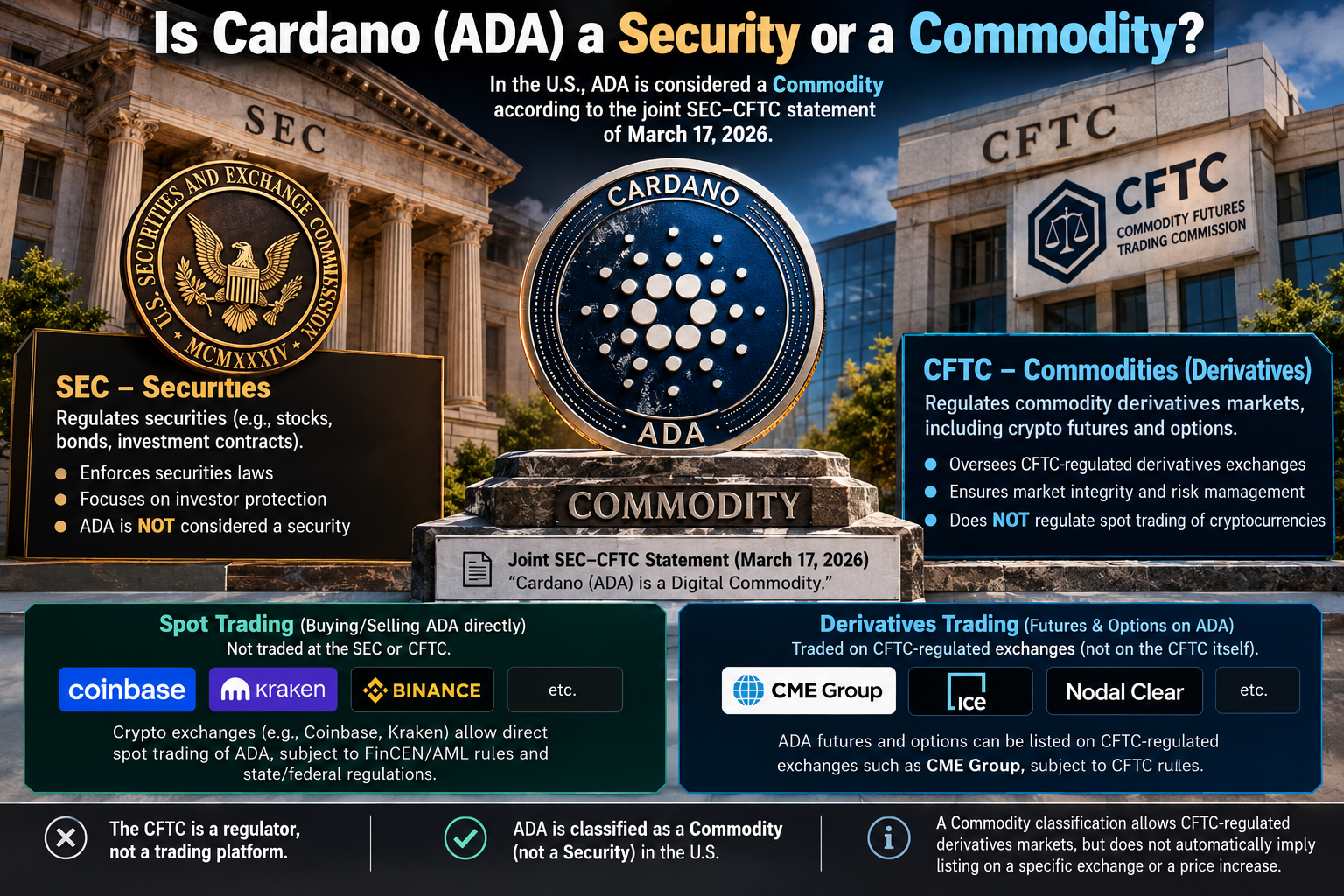
Is Cardano (ADA) a security or a commodity under U.S. law? The question matters to token holders, trading platforms, and stake pool operators. A regulatory interpretation issued by the Securities and Exchange Commission (SEC), with guidance from the Commodity Futures Trading Commission (CFTC), on March 17, 2026 provides a direct answer: Cardano (ADA) is explicitly listed as an example of a digital commodity. The interpretation took effect on March 23, 2026.
What did the SEC and CFTC say?
SEC Release No. 33-11412 explains how federal securities laws apply to several categories of crypto assets and to certain transactions involving those assets. The CFTC joined the release to provide corresponding guidance under the Commodity Exchange Act.
The SEC identifies categories including digital commodities, digital collectibles, digital tools, stablecoins, and digital securities. In its discussion of digital commodities, it expressly includes Cardano (ADA). In this framework, a digital commodity derives value from the programmatic operation of a functional crypto system and supply-and-demand dynamics rather than an expectation of profits from the essential managerial efforts of others.
There is an important legal qualification: A token not being a security in itself does not mean every transaction involving that token is exempt from securities law. Depending on the representations, promises, and circumstances of an offer, a non-security crypto asset may still be sold as part of an investment contract.
SEC vs. CFTC: What is the difference?
SEC: Securities regulation
The SEC administers federal securities laws. For crypto-related arrangements, the Howey test can help determine whether a transaction constitutes an investment contract, including whether purchasers expect profits from the essential efforts of others. The new interpretation distinguishes the nature of a crypto asset from the legal treatment of transactions involving it.
CFTC: Commodity derivatives oversight
The CFTC oversees U.S. commodity derivatives markets, including regulated futures and options markets for crypto-related products. The CFTC is a regulator, not an exchange where ADA is bought or sold. A digital commodity classification also does not make every ADA spot transaction subject to comprehensive CFTC exchange regulation, although the agency can have authority concerning fraud and manipulation in commodity markets.
Spot trading versus ADA derivatives
In spot trading, buyers and sellers exchange ADA directly through trading venues. Those venues are separate businesses, not the SEC or CFTC, and their obligations depend on applicable laws and business activities.
Derivatives trading involves contracts whose value depends on ADA, such as futures or options. Where such contracts are authorized and actually listed, they may trade on CFTC-regulated derivatives exchanges. Classification as a digital commodity does not by itself confirm that a particular ADA contract is listed, approved, or available to trade.
What does this mean for Cardano staking?
The SEC interpretation also addresses protocol staking on proof-of-stake networks. For the activities and conditions described in the release, the SEC concludes that protocol staking does not involve an offer or sale of securities. Its discussion includes certain self-custodial arrangements in which holders delegate validation rights to third-party node operators.
This is relevant to independent Cardano stake pools such as Hamster Stake Pool (HAMDA). It does not, however, create a blanket exemption for every staking product or service. Custody arrangements, additional promises, and the precise structure of an offering can change the legal analysis. Neither the interpretation nor delegation to a pool guarantees staking rewards or future price appreciation.
Conclusion: ADA is a digital commodity under the SEC interpretation
The SEC's March 17, 2026 interpretation expressly names Cardano (ADA) as a digital commodity. That provides greater clarity about how the token itself is treated under the agencies' stated U.S. framework, while preserving an important distinction between tokens, investment contracts, spot transactions, and derivatives.
The release is an agency interpretation of existing U.S. law, not a promise that legislation, court decisions, or regulatory practice will never change. For the Cardano ecosystem and decentralized stake pool operators, it is a significant clarification—but individual products and transactions still require their own legal assessment.
Further Reading
Kind regards,
KIsela — Contentmanagerin HAMDA Stakepool