Cardano Governance – CIP-1694 and the Voltaire Era
How Cardano has governed its own protocol on-chain since the Voltaire era — and how the HAMDA pool votes as a Stake Pool Operator.
What Is Cardano Governance?
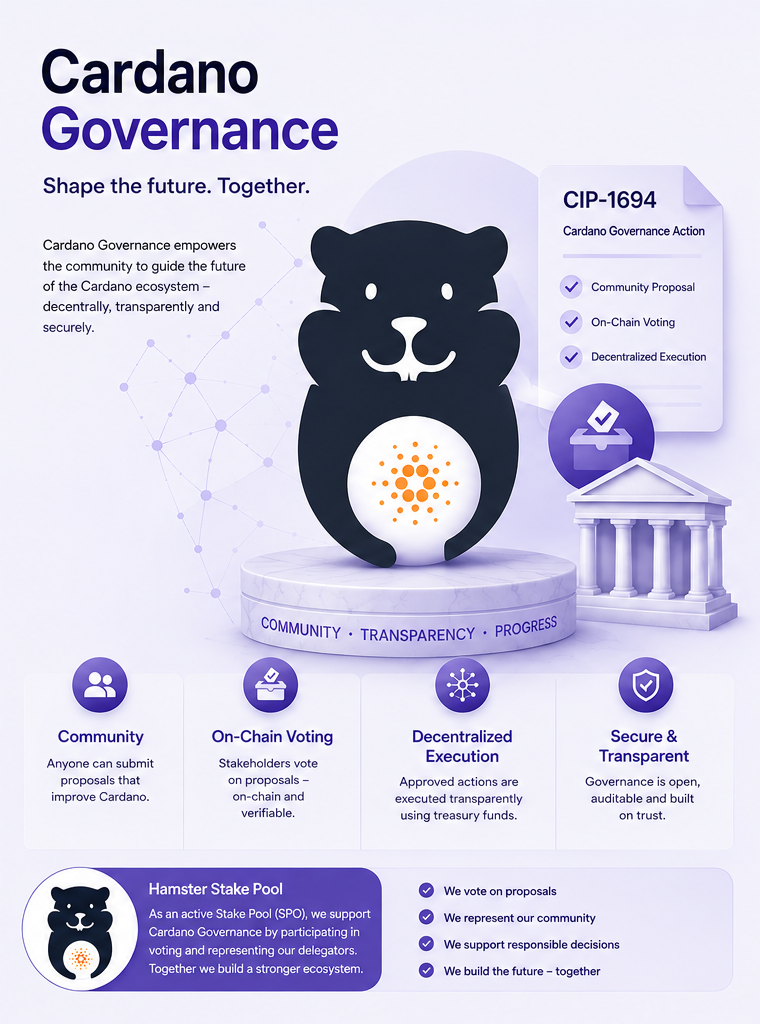
With the CIP-1694 standard and the Conway era, Cardano introduced a fully on-chain governance system — the "Voltaire" phase of the Cardano roadmap. Instead of centralized decision-making, three independent bodies vote directly on the blockchain on the network's future: Delegated Representatives (DReps), the Constitutional Committee, and Stake Pool Operators (SPOs).
Every change to the network — from protocol parameters to hard forks to treasury spending — goes through an on-chain vote called a "Governance Action" with its own Governance Action ID (GAID). The outcome is recorded transparently on the blockchain, verifiable by anyone.
This page doesn't just explain what Cardano governance is — it also shows exactly how the HAMDA pool voted as an SPO, and why, most recently on the hard fork to Protocol Version 11.
The three governance bodies
DReps – Delegated Representatives
ADA holders can delegate their voting power to a DRep or become one themselves. DReps vote on behalf of the ADA community on nearly all governance actions.
Constitutional Committee
An elected body that checks whether governance actions comply with the Cardano Constitution, approving or rejecting them accordingly.
SPOs – Stake Pool Operators
Stake pool operators like HAMDA vote with the stake delegated to them. Their vote counts primarily on security-critical matters such as hard forks, security-relevant protocol parameters, motions of no confidence, and the composition of the committee.
Types of governance actions
Adjusting technical network parameters, e.g. fees, block sizes, or security thresholds.
Initiating a protocol upgrade to a new Cardano version.
Releasing ADA from the community treasury for projects and initiatives.
Removing the current Constitutional Committee.
Appointing or removing members of the Constitutional Committee.
Amending the Cardano Constitution, which binds all future governance actions.
A non-binding sentiment poll of the community with no direct protocol change.
How SPOs Vote
Unlike DReps and the Constitutional Committee, an SPO's vote doesn't carry equal weight on every governance action. Stake-weighted SPO voting power mainly applies to security-critical decisions — such as hard forks, security-relevant protocol parameters, motions of no confidence, and the composition of the committee. For topics such as treasury withdrawals or a new constitution, voting power instead lies primarily with DReps and the Constitutional Committee.
HAMDA's Governance Votes
Every governance action the HAMDA pool has participated in as an SPO — live from the Cardano blockchain via the Koios API.
Should stakePoolTargetNum (k) be raised from 500 to 1000? (SPO poll)
Show details
This Info Action asks the Cardano community, and in particular Stake Pool Operators (SPOs), whether there is sufficient SPO support to proceed with a later Parameter Change Governance Action that would raise **`stakePoolTargetNum` (`k`)** from 500 to 1000. It follows the 2023 SPO poll but considers `stakePoolTargetNum` on its own. To determine whether sufficient SPO support exists, votes shall be tallied according to the standard CIP-1694 voting semantics; this proposal introduces no alternative turnout-based formula. SPO voting power is stake-weighted. An explicit ABSTAIN vote is excluded fr…
Reduce minPoolCost to 75 ada and increase Plutus Memory Limits (Part 2)
Show details
Intersect's Parameter Committee proposes a single Parameter Update governance action bundling two independent, previously recommended protocol parameter changes: 1. **minPoolCost:** decrease `minPoolCost` from 170,000,000 Lovelace (170 ada) to 75,000,000 Lovelace (75 ada), a decrease of approximately 55.9%. 2. **Plutus memory unit limits (Part 2 of 2):** increase maxTxExecutionUnits[memory] from 16,500,000 to 17,500,000 units (+6.1%) and maxBlockExecutionUnits[memory] from 72,000,000 to 77,500,000 units (+7.6%), completing the two-step, cumulative 25% increase to both parameters begun in th…
Update Constitutional Committee 2026
Show details
This governance action updates the four Constitutional Committee seats whose terms expire at the end of Epoch 653 by appointing the candidates elected through the 2026 Constitutional Committee election. The successful candidates will serve new terms ending at Epoch 799, in accordance with the current committeeMaxTermLength protocol parameter.
Name the Protocol Version 12 hard fork “von Bergen“
Show details
This info action proposes naming the Protocol Version 12 hard fork “von Bergen” as a salute and recognition to Fabian von Bergen, also known as Zyroxa. Fabian has been a Cardano community member since the ITN, an always critical, honest and sound voice in Cardano's past who introduced and guided many through the Cardano ecosystem, a well known person on the Cardano Forum, also SPO of the Tempus Stake Pool and a Cardano Ambassador since the earliest days of the program.
Hard Fork to Protocol Version 11 ('van Rossem' Hard Fork)
Show details
We propose to upgrade Cardano Mainnet to Protocol Version 11. This upgrade will be achieved via an intra-era Hard Fork (called "van Rossem"). Following the upgrade: 1. The Cardano mainnet protocol will be upgraded to Major Version 11 and Minor Version 0; 2. The ledger remains in the Conway era, there is no era transition; 3. Several new Plutus primitives will be available, as defined in CIP-0109, CIP-0132, CIP-0133, CIP-0138 and CIP-0153; 4. All Plutus built-in functions will be available consistently across Plutus V1, V2 and V3, expanding the capabilities of Plutus V1 and V2 scripts;…
Net Change Limit of 300 Million ADA for Epochs 613–713
Show details
This governance action proposes a Net Change Limit of 300,000,000,000,000 lovelace (300 million ADA) for the period from the start of Epoch 613 (13 February 2026) to the end of Epoch 713 (3 July 2027). Upon approval in accordance with the Constitution, this NCL shall apply to Epochs 613–713 and supersede any previously agreed NCL for the same period.
Increase Transaction and Block Memory Units (Part 1 of 2)
Show details
Intersect's Parameter Committee proposes the first of two Parameter Update governance actions. The following change is proposed together in this rationale, but will require two separate, linked governance actions as per guardrail MTEU-M-04. 1) increase Plutus script memory unit limits per transaction by 25% to allow greater flexibility for DApp developers. 2) increase Plutus script memory unit limits per block by 25% to remain consistent with the current block memory limits. No other protocol parameters or Plutus cost model setting will be changed.
Name Protocol Version 11 hard fork - van Rossem
Show details
Intersect’s Hard Fork Working Group proposes to name the next Cardano hard fork, to Protocol Version 11, the “van Rossem Hard Fork” in memory of Cardano community contributor Max van Rossem.
Hard Fork Initiation
Frequently Asked Questions About Cardano Governance
What is CIP-1694?
CIP-1694 is the Cardano Improvement Proposal that introduced a fully on-chain governance system with the Conway era — the "Voltaire" phase of the Cardano roadmap. It defines the three voting bodies, DReps, the Constitutional Committee, and SPOs, along with the governance actions they vote on.
What is a governance action?
A governance action is an on-chain proposal to change the Cardano network — such as a protocol parameter change, a hard fork, or a treasury withdrawal. Each action gets its own governance action ID and is voted on transparently on the blockchain.
How does a Stake Pool Operator (SPO) vote?
An SPO casts its vote via an on-chain transaction signed with the pool's cold key. The vote counts with the weight of the active stake delegated to that pool.
Which governance actions can SPOs vote on?
SPO votes count primarily on security-critical decisions: hard fork initiation, security-relevant protocol parameters, motions of no confidence, committee updates, and info actions. For treasury withdrawals and a new constitution, voting power lies primarily with DReps and the Constitutional Committee.
How has the HAMDA pool voted so far?
The HAMDA pool has participated in several governance actions so far, including the hard fork to Protocol Version 11. The full voting record, loaded live from the blockchain, is listed above on this page.
What's the difference between a DRep and an SPO when voting?
DReps represent the ADA holders who delegated their voting power to them and vote on nearly all governance actions. SPOs, on the other hand, vote with the stake delegated to them and mainly hold voting power on security-relevant topics — the weighting differs by action type.
Can I participate in governance as an ADA holder?
Yes. As an ADA holder, you can delegate your voting power to a DRep, or register as a DRep yourself to vote directly on governance actions.