Cardano Governance – CIP-1694 & die Voltaire-Ära
Wie Cardano seit der Voltaire-Ära dezentral über sein eigenes Protokoll entscheidet – und wie der HAMDA Pool als Stake Pool Operator dabei konkret abstimmt.
Was ist Cardano Governance?
Mit dem Standard CIP-1694 und der Conway-Ära hat Cardano ein vollständig On-Chain-basiertes Governance-System eingeführt – die "Voltaire"-Phase der Cardano-Roadmap. Statt zentraler Entscheidungen stimmen drei unabhängige Gremien direkt auf der Blockchain über die Zukunft des Netzwerks ab: Delegated Representatives (DReps), das Constitutional Committee und die Stake Pool Operatoren (SPOs).
Jede Änderung am Netzwerk – von Protokollparametern über Hard Forks bis zur Verwendung des Treasury – läuft als sogenannte "Governance Action" über eine On-Chain-Abstimmung mit eigener Governance Action ID (GAID). Das Ergebnis wird transparent und für jeden nachvollziehbar auf der Blockchain gespeichert.
Auf dieser Seite erklären wir nicht nur, was Cardano Governance ist, sondern zeigen auch konkret, wie der HAMDA Pool als SPO abgestimmt hat und warum – zuletzt etwa beim Hard Fork auf Protocol Version 11.
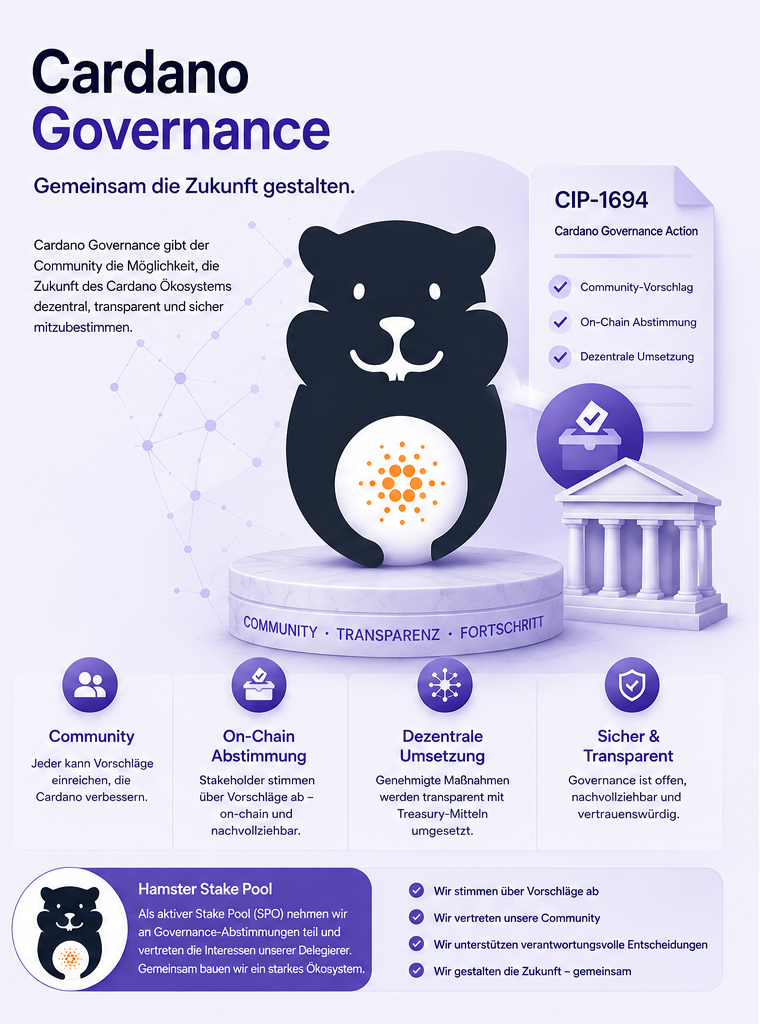
Die drei Governance-Gremien
DReps – Delegated Representatives
ADA-Halter können ihre Stimmrechte an einen DRep delegieren oder selbst einer werden. DReps stimmen im Namen der ADA-Community über nahezu alle Governance Actions ab.
Constitutional Committee
Ein gewähltes Gremium, das prüft, ob Governance Actions mit der Cardano-Verfassung übereinstimmen, und diese entsprechend bestätigt oder ablehnt.
SPOs – Stake Pool Operatoren
Stake Pool Betreiber wie HAMDA stimmen mit dem ihnen delegierten Stake-Gewicht ab. Ihre Stimme zählt vor allem bei sicherheitsrelevanten Themen wie Hard Forks, sicherheitsrelevanten Protokollparametern, Misstrauensanträgen und der Besetzung des Committees.
Arten von Governance Actions
Anpassung technischer Netzwerkparameter, z. B. Gebühren, Blockgrößen oder Sicherheitsgrenzen.
Einleitung eines Protokoll-Upgrades auf eine neue Cardano-Version.
Freigabe von ADA aus dem gemeinschaftlichen Treasury für Projekte und Initiativen.
Abwahl des aktuellen Constitutional Committee.
Berufung oder Abberufung von Mitgliedern des Constitutional Committee.
Änderung der Cardano-Verfassung, die alle künftigen Governance Actions bindet.
Unverbindliche Stimmungsabfrage der Community ohne direkte Protokolländerung.
Wie SPOs abstimmen
Anders als bei DReps und dem Constitutional Committee zählt die Stimme eines SPOs nicht bei jeder Governance Action gleichermaßen. Stake-gewichtetes SPO-Stimmrecht ist vor allem bei sicherheitskritischen Entscheidungen vorgesehen – etwa Hard Forks, sicherheitsrelevanten Protokollparametern, Misstrauensanträgen und der Zusammensetzung des Committees. Bei Themen wie Treasury-Auszahlungen oder einer neuen Verfassung liegt das Stimmrecht dagegen vorrangig bei DReps und dem Constitutional Committee.
Governance-Abstimmungen von HAMDA
Jede Governance Action, an der der HAMDA Pool als SPO teilgenommen hat – live von der Cardano-Blockchain über die Koios API.
Should stakePoolTargetNum (k) be raised from 500 to 1000? (SPO poll)
Details anzeigen
This Info Action asks the Cardano community, and in particular Stake Pool Operators (SPOs), whether there is sufficient SPO support to proceed with a later Parameter Change Governance Action that would raise **`stakePoolTargetNum` (`k`)** from 500 to 1000. It follows the 2023 SPO poll but considers `stakePoolTargetNum` on its own. To determine whether sufficient SPO support exists, votes shall be tallied according to the standard CIP-1694 voting semantics; this proposal introduces no alternative turnout-based formula. SPO voting power is stake-weighted. An explicit ABSTAIN vote is excluded fr…
Reduce minPoolCost to 75 ada and increase Plutus Memory Limits (Part 2)
Details anzeigen
Intersect's Parameter Committee proposes a single Parameter Update governance action bundling two independent, previously recommended protocol parameter changes: 1. **minPoolCost:** decrease `minPoolCost` from 170,000,000 Lovelace (170 ada) to 75,000,000 Lovelace (75 ada), a decrease of approximately 55.9%. 2. **Plutus memory unit limits (Part 2 of 2):** increase maxTxExecutionUnits[memory] from 16,500,000 to 17,500,000 units (+6.1%) and maxBlockExecutionUnits[memory] from 72,000,000 to 77,500,000 units (+7.6%), completing the two-step, cumulative 25% increase to both parameters begun in th…
Update Constitutional Committee 2026
Details anzeigen
This governance action updates the four Constitutional Committee seats whose terms expire at the end of Epoch 653 by appointing the candidates elected through the 2026 Constitutional Committee election. The successful candidates will serve new terms ending at Epoch 799, in accordance with the current committeeMaxTermLength protocol parameter.
Name the Protocol Version 12 hard fork “von Bergen“
Details anzeigen
This info action proposes naming the Protocol Version 12 hard fork “von Bergen” as a salute and recognition to Fabian von Bergen, also known as Zyroxa. Fabian has been a Cardano community member since the ITN, an always critical, honest and sound voice in Cardano's past who introduced and guided many through the Cardano ecosystem, a well known person on the Cardano Forum, also SPO of the Tempus Stake Pool and a Cardano Ambassador since the earliest days of the program.
Hard Fork to Protocol Version 11 ('van Rossem' Hard Fork)
Details anzeigen
We propose to upgrade Cardano Mainnet to Protocol Version 11. This upgrade will be achieved via an intra-era Hard Fork (called "van Rossem"). Following the upgrade: 1. The Cardano mainnet protocol will be upgraded to Major Version 11 and Minor Version 0; 2. The ledger remains in the Conway era, there is no era transition; 3. Several new Plutus primitives will be available, as defined in CIP-0109, CIP-0132, CIP-0133, CIP-0138 and CIP-0153; 4. All Plutus built-in functions will be available consistently across Plutus V1, V2 and V3, expanding the capabilities of Plutus V1 and V2 scripts;…
Net Change Limit of 300 Million ADA for Epochs 613–713
Details anzeigen
This governance action proposes a Net Change Limit of 300,000,000,000,000 lovelace (300 million ADA) for the period from the start of Epoch 613 (13 February 2026) to the end of Epoch 713 (3 July 2027). Upon approval in accordance with the Constitution, this NCL shall apply to Epochs 613–713 and supersede any previously agreed NCL for the same period.
Increase Transaction and Block Memory Units (Part 1 of 2)
Details anzeigen
Intersect's Parameter Committee proposes the first of two Parameter Update governance actions. The following change is proposed together in this rationale, but will require two separate, linked governance actions as per guardrail MTEU-M-04. 1) increase Plutus script memory unit limits per transaction by 25% to allow greater flexibility for DApp developers. 2) increase Plutus script memory unit limits per block by 25% to remain consistent with the current block memory limits. No other protocol parameters or Plutus cost model setting will be changed.
Name Protocol Version 11 hard fork - van Rossem
Details anzeigen
Intersect’s Hard Fork Working Group proposes to name the next Cardano hard fork, to Protocol Version 11, the “van Rossem Hard Fork” in memory of Cardano community contributor Max van Rossem.
Hard Fork to Protocol Version 10 ("Plomin" Hard Fork)
Details anzeigen
We propose to upgrade Cardano mainnet to Protocol Version 10. This upgrade will be achieved via a Hard Fork (called "Plomin"). Following the upgrade: 1. The Cardano mainnet protocol will be upgraded to Major Version 10 and Minor Version 0; 2. All 7 governance actions that are described in CIP-1694 will be enabled; 3. DRep voting will be enabled on all 7 governance actions; 4. SPO voting will be enabled on all applicable governance actions, as defined in CIP-1694; 5. Constitutional Committee voting will be enabled on all applicable governance actions, also as defined in CIP-1694; 6. Staking r…
Häufige Fragen zu Cardano Governance
Was ist CIP-1694?
CIP-1694 ist der Cardano Improvement Proposal, der mit der Conway-Ära ein vollständig On-Chain-basiertes Governance-System einführt – die "Voltaire"-Phase der Cardano-Roadmap. Er definiert die drei Abstimmungsgremien DReps, Constitutional Committee und SPOs sowie die Governance Actions, über die sie abstimmen.
Was ist eine Governance Action?
Eine Governance Action ist ein On-Chain-Vorschlag zur Änderung des Cardano-Netzwerks – etwa eine Protokollparameter-Änderung, ein Hard Fork oder eine Treasury-Auszahlung. Jede Action erhält eine eigene Governance Action ID und wird transparent auf der Blockchain abgestimmt.
Wie stimmt ein Stake Pool Operator (SPO) ab?
Ein SPO gibt seine Stimme direkt über eine On-Chain-Transaktion ab, die mit dem Cold Key des Pools signiert wird. Die Stimme zählt mit dem Gewicht des dem Pool delegierten aktiven Stakes.
Bei welchen Governance Actions haben SPOs Stimmrecht?
SPO-Stimmen zählen vor allem bei sicherheitskritischen Entscheidungen: Hard Fork Initiation, sicherheitsrelevante Protokollparameter, Misstrauensanträge, Committee-Aktualisierungen und Info Actions. Bei Treasury-Auszahlungen und einer neuen Verfassung liegt das Stimmrecht vorrangig bei DReps und dem Constitutional Committee.
Wie hat der HAMDA Pool bisher abgestimmt?
Der HAMDA Pool hat bislang an mehreren Governance Actions teilgenommen, unter anderem am Hard Fork auf Protocol Version 11. Die vollständige, live von der Blockchain geladene Abstimmungshistorie findest du oben auf dieser Seite.
Was ist der Unterschied zwischen einem DRep und einem SPO beim Voting?
DReps vertreten die ADA-Halter, die ihre Stimmrechte an sie delegiert haben, und stimmen über nahezu alle Governance Actions ab. SPOs stimmen dagegen mit dem ihnen delegierten Stake und haben vor allem bei sicherheitsrelevanten Themen Stimmrecht – die Gewichtung unterscheidet sich je nach Action-Typ.
Kann ich als ADA-Halter selbst mitbestimmen?
Ja. Als ADA-Halter kannst du deine Stimmrechte an einen DRep delegieren oder dich selbst als DRep registrieren, um direkt über Governance Actions abzustimmen.