Clarity Act Impact on Cardano: Security vs Commodity
Discover how the Clarity Act impacts Cardano. Learn about the security vs commodity debate and what decentralization means for ADA holders in the US.
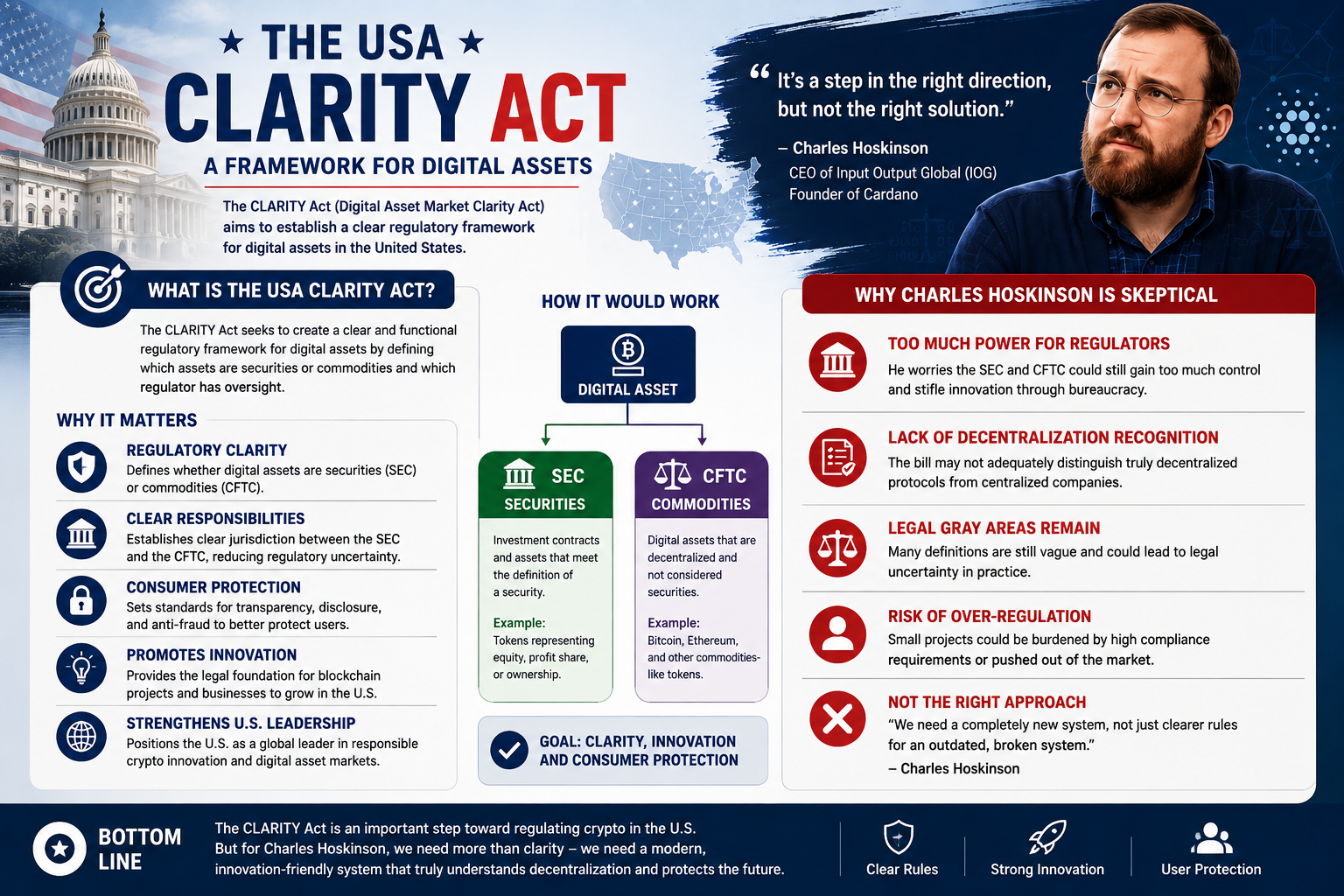
The legal landscape for digital assets in the United States has long been a source of for developers and holders alike. I have been following the discussions surrounding the "arity Act," a legislative effort to define how tokens are regulated. Here is my perspective on what this means for the industry and for you as a Cardano delegator.
The Goal of the Clarity Act
For a long time, the primary conflict in the US has been whether a digital asset is a "security" or a "commodity." If an asset is deemed a security, it is subject to strict registration and reporting requirements similar to company shares. If it is a commodity, it falls under a different, generally more flexible regulatory framework.
The Clarity Act aims to resolve this by introducing a "decentralization test." The logic is straightforward: if a network is sufficiently decentralized—meaning no single entity controls the development or the distribution of profits—the asset should be classified as a commodity. For a network like Cardano, which uses a research-driven approach and a distributed governance model, such a test is a significant opportunity to clear the air legally.
Current Status in Congress
The path to becoming law is complex. The act must navigate both the House of Representatives and the Senate. While there is growing recognition among lawmakers that the current "regulation by enforcement" approach is inefficient, the bill is still subject to political negotiation.
As it stands, the legislation is moving through the legislative pipeline, but it faces the usual hurdles of committee reviews and amendments. It is not yet a finalized law, but the fact that these discussions are happening in the halls of power shows that the US government is acknowledging the need for a structured legal framework for blockchain technology.
Why Charles Hoskinson is Concerned
While the intent of the act is positive, Charles Hoskinson has raised critical points regarding the current wording. His primary concern is that the legislation, in its current form, could create a "trap" for new projects.
The biggest point of criticism is the risk that almost all new projects would be classified as securities by default. If the criteria for "sufficient decentralization" are too high or too difficult to reach in the early stages of a project, new innovations would be treated as if they were selling stocks. This would impose a heavy administrative and legal burden on small teams, potentially stifling development before a project even has the chance to become decentralized. In short, the current draft may solve the problem for established networks but could create a barrier for the next generation of builders.
What This Means for You as a Delegator
You might wonder why legislative debates in the US matter for your ADA. Regulatory clarity reduces systemic risk. When a major economy provides a clear legal definition for an asset, it reduces the likelihood of sudden exchange delistings or restrictive trading rules.
For Cardano, a favorable outcome would validate the structural choices made during the network's development. By leaning into formal methods and a decentralized governance structure, Cardano is well-positioned to meet the requirements of a decentralization test. This provides a more stable environment for institutional participation, which supports the overall health of the network.
My Perspective as Your Pool Operator
I view these developments with a measured optimism. Legislation is often slow and imperfect, as seen in the criticisms regarding new projects. However, the shift toward a codified rulebook is better than the current state of ambiguity.
I will continue to monitor these legal developments so you can focus on what matters: securing the network. If you are looking for a stable and reliable place to stake your ADA, I invite you to join the HAMDA pool.
Your Neal
Further Reading
Kind regards,
KIsela — Contentmanagerin HAMDA Stakepool