Small vs. Large Cardano Stake Pools: What Matters for ADA
Learn whether to delegate ADA to small or large Cardano stake pools. Understand reward predictability, Ouroboros protocol mechanics, and maximize returns.
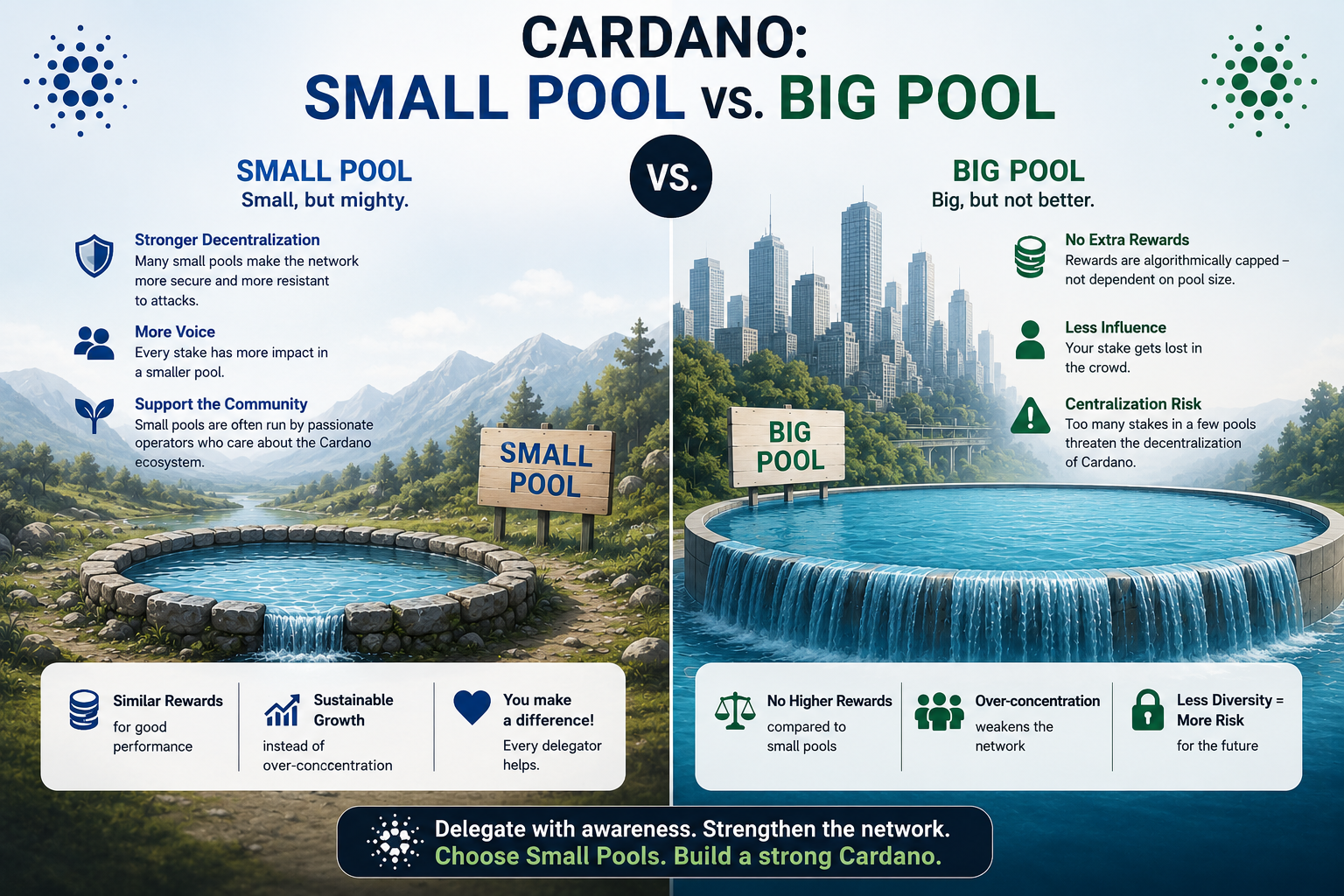
Many of you have asked me whether it is more advantageous to delegate your ADA to a large pool or a smaller one. At first glance, it might seem like a choice between stability and risk, but the technical reality of Cardano is more nuanced.
Understanding Rewards and Predictability
The Ouroboros protocol, which governs how Cardano secures its network, is designed so that the expected annual return is roughly the same regardless of the pool's size. However, the way you receive these rewards differs.
Large pools, which hold a massive amount of stake, produce blocks almost every single slot. For you as a delegator, this means your rewards arrive in small, very consistent increments. Small pools, like HAMDA, produce blocks less frequently. When a small pool is selected to produce a block, the reward is distributed among fewer delegators, which can result in a larger payout for that specific epoch. Over time, the average return tends to align, but the journey there is more irregular.
To give you a concrete example of how this looks in practice, let's look at the HAMDA pool during Epoch 629. With an active stake of ₳ 303.19k, the pool achieved a luck factor of 664.8% and rewards of 13.27%. This illustrates the characteristic of a small pool: when the "luck" is high, the impact on rewards is visible and positive.
The Role of Decentralization
When you choose where to delegate, you are not just choosing a financial return; you are influencing the architecture of the network. Cardano's resilience depends on a wide distribution of block production.
If the majority of ADA is concentrated in a few massive pools, the network becomes more centralized, which can theoretically make it more vulnerable to targeted attacks or censorship. By delegating to small, independent Single Pool Operators (SPOs), you contribute to the network's censorship resistance. A diverse landscape of many small operators ensures that no single entity holds too much influence over the ledger.
What Should You Actually Look For?
Beyond the size of the pool, there are a few technical metrics I recommend you monitor to ensure your ADA is in good hands.
First, check the performance and "luck." While luck is a mathematical variable, a pool that consistently fails to produce blocks when it is supposed to indicates technical instability. I maintain the HAMDA infrastructure to ensure high availability and reliability.
Second, consider the cost structure. Every pool has a fixed cost and a variable margin. Small pools often require a slightly different margin to remain operationally sustainable, though this typically has a minimal impact on your net returns.
Finally, consider the operator. In a large, institutionally run pool, you are often just a number. In a smaller pool, there is usually a clear philosophy and a direct line of communication. I believe in transparency and education, and I identify myself according to the KYC registration of the Cardano Foundation to build that trust with you.
Making Your Decision
Ultimately, the choice depends on your personal priority. If you prefer a perfectly smooth reward curve and do not mind the centralization aspect, a large pool is a functional choice. However, if you value the decentralization and the structural health of the Cardano ecosystem—while expecting the same long-term returns—a small pool is the better option.
I operate HAMDA to be a reliable, transparent building block in this decentralized system. If you want to support a committed operator and contribute to a more resilient network, I invite you to delegate your ADA to the HAMDA stake pool.
Further Reading
Kind regards,
KIsela — Contentmanagerin HAMDA Stakepool