Cardano Staking Rewards Guide: How to Delegate ADA Safely
Learn how Cardano staking rewards work and how to delegate your ADA safely. Your funds remain liquid while you earn passive income via stake pools.
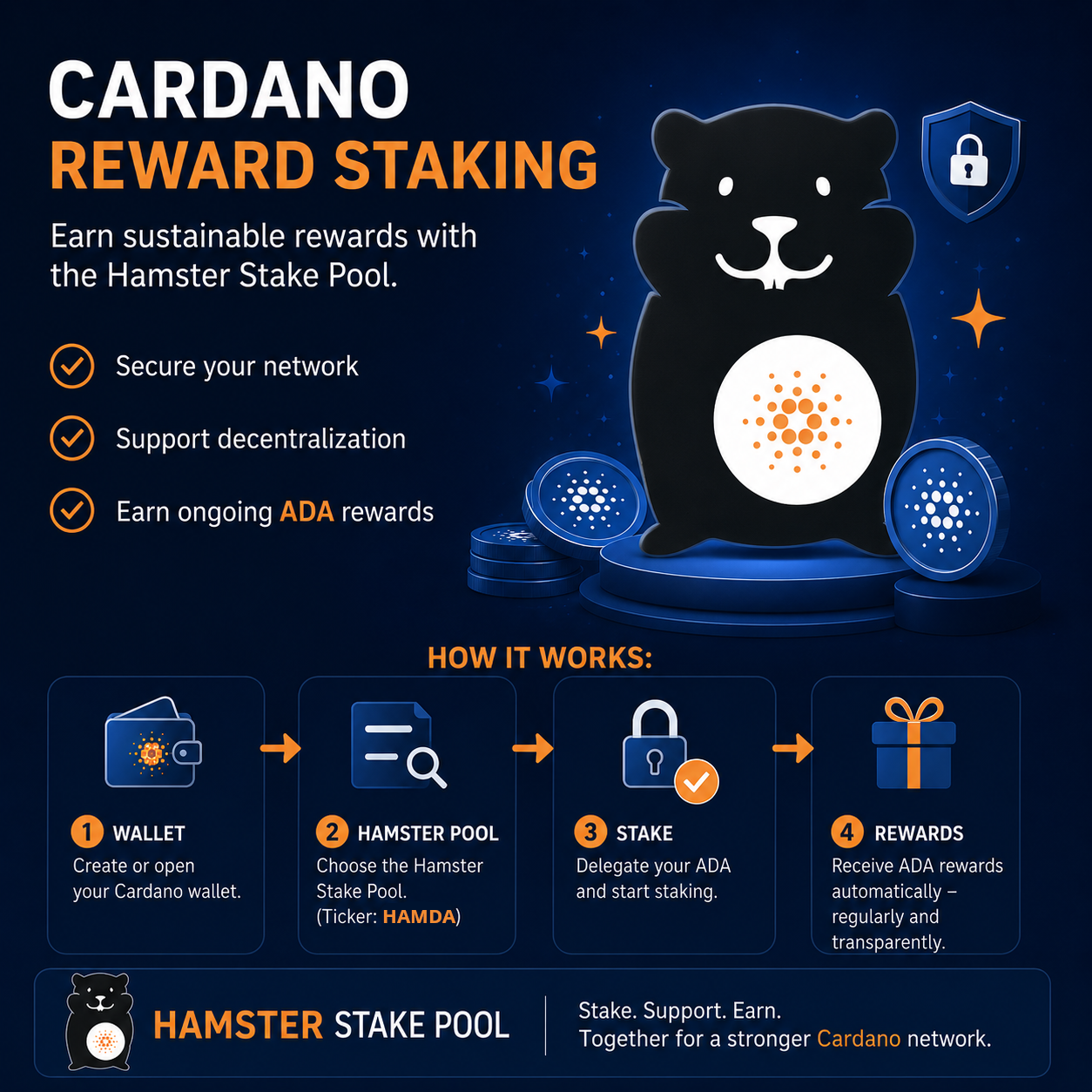
You might have noticed that your ADA is doing more than just sitting in your wallet. If you haven't yet started staking, you are missing out on a fundamental feature of the Cardano ecosystem that allows your holdings to grow while supporting the network.
Your ADA as Your Stake
In the Cardano ecosystem, every ADA you hold represents a "stake" in the network. When you engage in staking, you are essentially putting that stake to work to secure the blockchain.
I want to be clear about one thing from the start: staking on Cardano does not require you to lock up your funds. Your ADA remains in your wallet under your control at all times. You are not sending your coins to me or any other operator; you are simply delegating the "staking rights" associated with your coins. This means you maintain full liquidity and can move your funds whenever you wish.
The Role of Stake Pools
To understand how rewards are generated, it helps to understand what I do as a pool operator. A stake pool is a server infrastructure that stays connected to the network 24/7 to produce blocks.
Cardano uses a consensus mechanism called Ouroboros (a Proof-of-Stake system). In simple terms, the network chooses which pool gets to create the next block based on the total amount of ADA delegated to that pool. The more stake a pool has, the higher its probability of being selected. By delegating your ADA to my pool, HAMDA, you increase the pool's chance of producing a block, which in turn allows the pool to earn rewards for its delegators.
How Rewards are Calculated and Distributed
Rewards come from two primary sources: transaction fees paid by users and newly minted ADA. These rewards are distributed in regular intervals to all delegators of a pool that has successfully produced blocks.
Your individual payout is directly proportional to the amount of ADA you have delegated. If you hold a larger share of the pool's total stake, you receive a larger share of the rewards. I manage the pool's performance by balancing factors such as the "pledge" (the amount of my own ADA I have committed to the pool) and ensuring high server reliability. These factors influence the overall profitability and stability of the rewards you receive.
Strengthening the Network Through Delegation
Staking is more than just a way to earn passive rewards; it is a contribution to the health of the entire ecosystem. The security of Cardano depends on decentralization. When you delegate your stake to a reliable pool, you prevent a few large entities from dominating the network.
By choosing a pool that prioritizes stability and transparency, you help ensure that the network remains distributed and resistant to attacks. You move from being a passive holder to an active participant in the governance and security of the blockchain.
Start Your Staking Journey
Delegating your stake is a straightforward process that takes only a few clicks within your wallet, whether you use a light wallet like Yoroi or a full node like Daedalus. Because there is no locking period and no risk of losing your funds through delegation, it is one of the most secure ways to interact with the network.
If you are looking for a stable and transparent environment for your ADA, I invite you to delegate your stake to the HAMDA pool. Together, we can contribute to a more decentralized Cardano while growing your holdings.
Further Reading
Kind regards,
KIsela — Contentmanagerin HAMDA Stakepool