75 ADA Minimum Pool Fee Rejected Again: A Missed Opportunity for Small Cardano Pools
Cardano's proposed reduction of minPoolCost from 170 to 75 ADA has failed for the second time. Why this saddens me as the Hamster Stake Pool operator and what small pools and delegators could have gained.
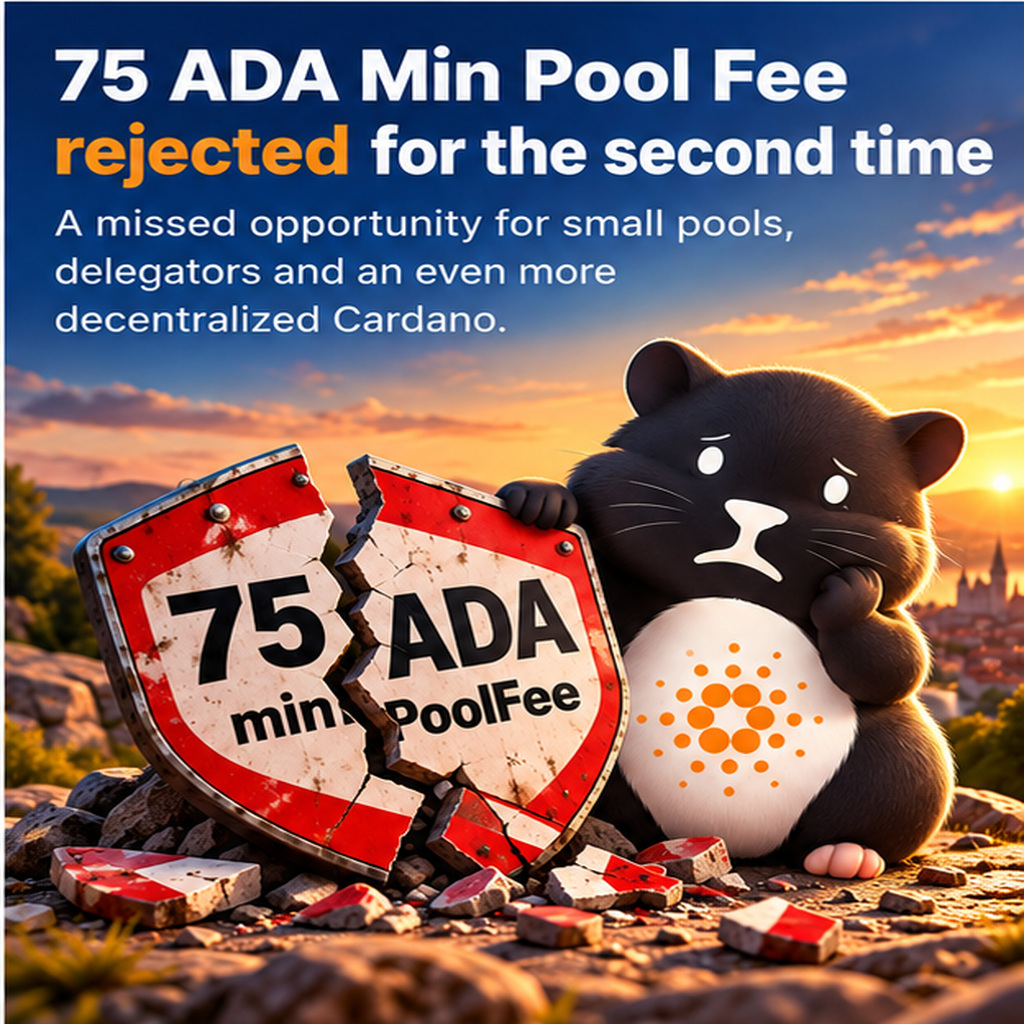
A second attempt, a second failure
I am sad and disappointed: the second attempt to lower Cardano's minimum pool cost (minPoolCost) from 170 to 75 ADA has failed. The proposed change would have reduced the minimum by approximately 55.9%. The second governance action expired in October 2026 without ratification. Published voting data shows roughly 44.1% DRep support against the required 67% threshold. The Constitutional Committee, by contrast, met its threshold with support from five of seven members.
What happened the first time?
In September 2026, an earlier governance action also expired. It combined the 75 ADA reduction with an increase in Plutus memory limits. DReps and the Constitutional Committee gave sufficient support, but the required stake pool operator approval was missing: approximately 34.5% of the relevant SPO stake voted yes, below the 51% threshold. The second proposal addressed minPoolCost alone and did not require an SPO vote. The voting circumstances differed, but the proposed lower fee failed both times.
Why the fixed fee hits small pools harder
minPoolCost is not an extra charge taken from a delegator's wallet. It sets the minimum fixed pool cost deducted from a pool's epoch rewards before the remainder is shared among delegators. For a large pool producing many blocks, the fixed amount is spread over a much larger reward total. For a small pool producing only one block in an epoch, it can consume a substantial share.
Consider a simplified example: if a pool earns 300 ADA in gross rewards for an epoch and charges a fixed fee of 170 ADA, 130 ADA remains for further distribution. At a fixed fee of 75 ADA, 225 ADA would remain. That is 95 ADA more in the shared reward pot, before accounting for pool margin and stake-based distribution. This is illustrative, not a guaranteed payout. Crucially, lowering the protocol minimum would not have forced operators to reduce their actual declared fee.
What small pools and delegators could have gained
A lower minimum could have allowed smaller pools to offer more competitive staking returns. Delegators choosing to support independent operators could have faced a smaller reward disadvantage. In turn, small pool operators might have found it easier to attract delegation and sustain their infrastructure.
Cardano's decentralization could also have benefited. Reducing the fixed-fee disadvantage would make it easier for stake to spread across a wider range of operators instead of favoring already-large pools. That would be a potential benefit, not an automatic guarantee.
My perspective as the Hamster Stake Pool operator
I run Hamster Stake Pool (HAMDA) because I believe Cardano should give small, independent pools a fair chance. That is why this second failure makes me genuinely sad. Small operators invest time, money and commitment into infrastructure and their communities. Delegators who support them should not have to accept an unnecessarily large reward disadvantage.
Of course, pool operators need to cover real operating costs. But I do not believe a rigid minimum fee that consumes such a large share of a small pool's rewards is the best way to achieve that.
What comes next?
For now, minPoolCost remains at 170 ADA. The discussion should not end here. PCP-006 and longer-term approaches, including fee structures that better reflect actual pool rewards, remain worth considering. I hope DReps, operators and delegators can work toward a solution that better balances economic sustainability with meaningful decentralization.
My message remains simple: Small pools are not a side issue. They are an important part of a diverse Cardano network.
Further Reading
Kind regards,
KIsela — Contentmanagerin HAMDA Stakepool