Hamster Pool Joins Cardano Musashi Dojo Leios Testnet
Hamster Stake Pool joins Cardano Musashi Dojo Leios testnet. Discover how this scaling upgrade impacts staking and network throughput for delegators now.
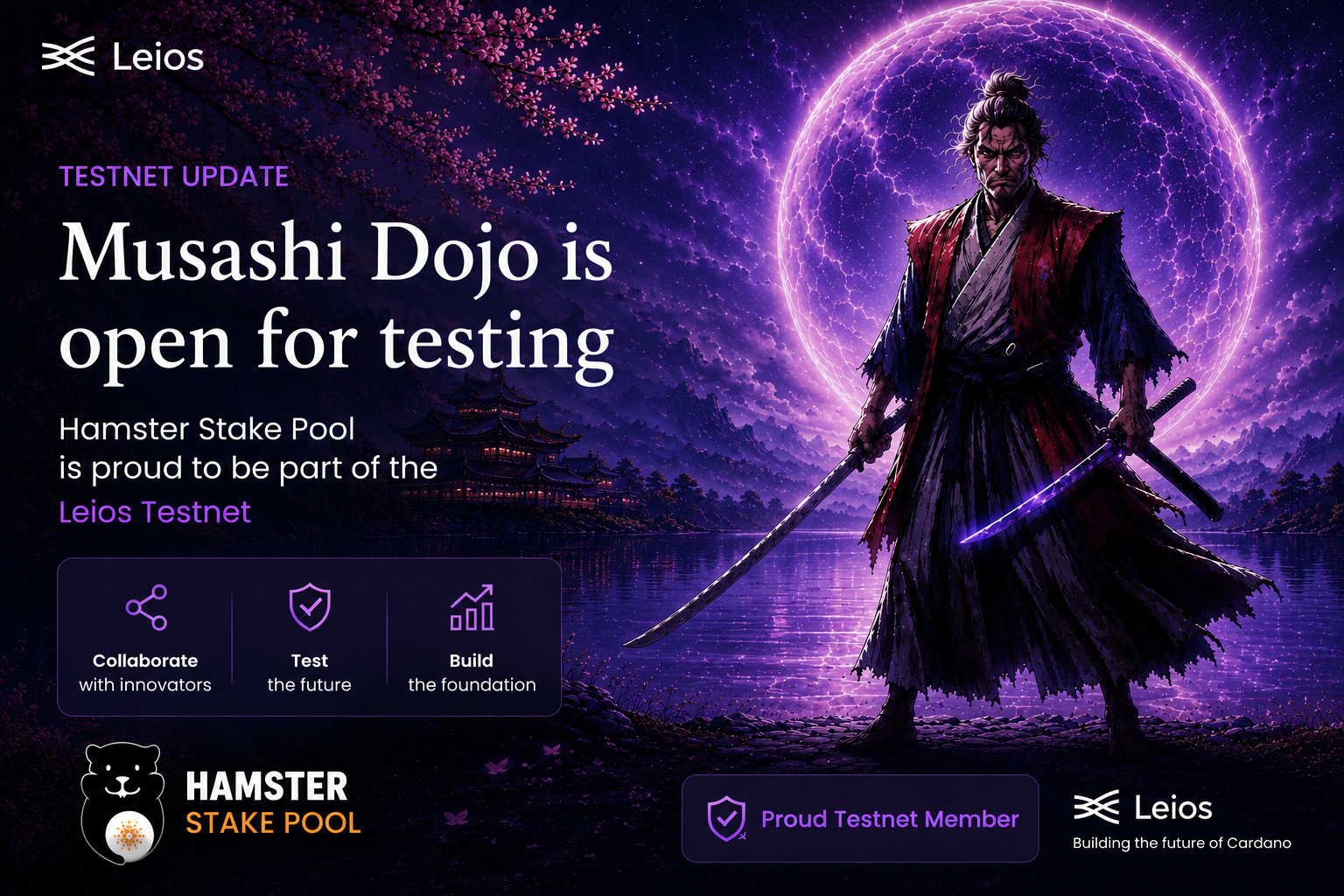
The Cardano network is currently undergoing a significant phase of technical evaluation regarding its capacity and speed. I am pleased to share that our pool, HAMDA, is actively participating in this process.
Understanding the Musashi Dojo
For those following the technical evolution of Cardano, you may have heard of Ouroboros Leios. This is the latest scaling concept designed to increase the network's throughput. To test these theories in a live environment, the "Musashi Dojo" testnet has been launched. The name is a tribute to the Japanese community and the philosophy of Miyamoto Musashi, emphasizing discipline and continuous refinement.
The Musashi Dojo serves as an open testing ground. It allows developers and pool operators to observe how the network behaves under specific conditions before any changes are implemented on the mainnet. You can monitor the activity of this environment through the official portal and the Kleio explorer.
Why Scaling Matters for You
As a delegator, you might wonder why a testnet is relevant to your experience. The primary goal of Leios is to improve data availability and enable better parallelization. In simple terms, parallelization allows the network to process multiple transactions simultaneously rather than in a strict linear sequence, which reduces bottlenecks.
To make these improvements measurable, the Dojo utilizes specific tools. A throughput model calculates how many transactions per second are theoretically possible, while the Cost Estimator and Mempool Visualizer provide real-time data on how transactions are queued and processed. These tools provide a factual basis for the expected performance increases in the future.
The Role of HAMDA in the Testnet
I believe that being a responsible pool operator means more than just maintaining a server for the mainnet. It involves active participation in the ecosystem's growth. That is why I have decided to run a test pool within the Musashi Dojo.
By operating in this environment, I am gaining first-hand experience with the technical foundations of the upcoming network upgrades. This allows me to identify potential issues and provide direct feedback to the Input Output (IOG) team. When we encounter bugs or inefficiencies in the testnet, we can report them immediately, helping to ensure that the eventual mainnet rollout is stable and reliable.
Transparency and Verification
Cardano is built on the principle of openness, and the Leios testnet is no exception. The results of these tests are not kept behind closed doors; they are available for anyone to inspect.
If you visit the Kleio explorer, you can see exactly which pools are participating in the Dojo. You can verify that HAMDA is active and observe the processes we are running in parallel with our mainnet operations. This transparency ensures that the community can hold operators and developers accountable to the data.
Moving Forward Together
The work being done in the Musashi Dojo lays the groundwork for a more capable Cardano. While these updates are still in the testing phase, the knowledge gained now will be essential for the stability of the network later.
I intend to keep you updated on these developments as they progress. My goal is to translate these technical milestones into clear information, so you understand exactly how the network is evolving.
If you value a pool operator who takes an active role in the technical health and future scalability of the network, I invite you to delegate your ADA to the HAMDA stake pool. Together, we can support a robust and scalable Cardano.
Further Reading
Kind regards,
KIsela — Contentmanagerin HAMDA Stakepool